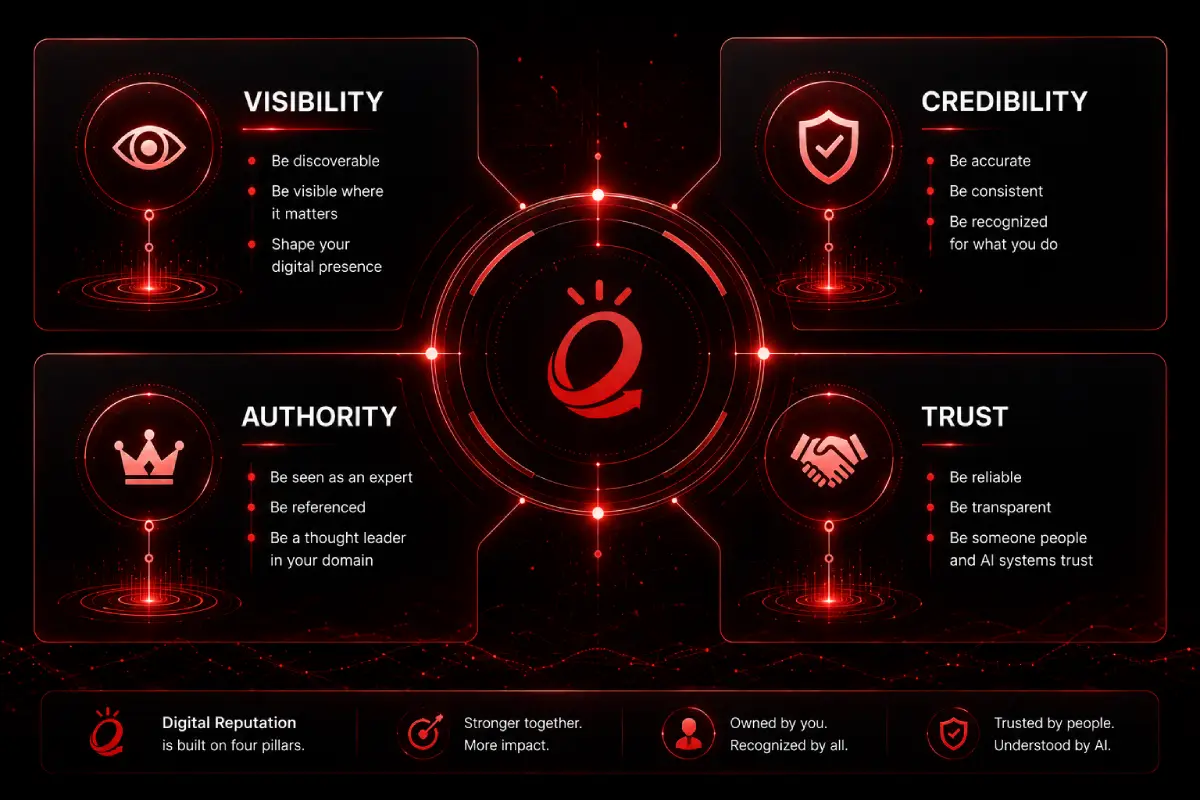
Digital Reputation can feel abstract if it is explained only as “how people see you online.” That definition is too broad to be useful and too narrow to be strategic. A better way to understand Digital Reputation is to break it into four public dimensions: visibility, credibility, authority and trust.
These four dimensions are not the full internal logic behind Digital Reputation, but they are the clearest public language for understanding how reputation is built in the digital world.
1. Visibility
Visibility is the starting point. If the right people cannot find you, your work, your ideas or your institution, reputation cannot do much work for you.
Visibility is about discoverability. It includes where you show up, how consistently you appear, whether your digital footprint is active and whether someone can understand what you do from the digital signals available.
A student with no professional digital footprint may have talent but low visibility. A founder with scattered presence across platforms may have some visibility but poor coherence. An institution with strong achievements but weak digital amplification may still remain invisible to the audiences it wants to reach.
Visibility is not the whole of Digital Reputation, but without it the rest of the picture is harder to build.
2. Credibility
Credibility answers a different question: do you look believable, serious and worth paying attention to?
Credibility is shaped by proof, clarity, consistency and quality of presence. It is the difference between simply being visible and being taken seriously.
A professional with a well-structured profile, clear expertise, visible contributions and evidence of work is more credible than someone with a vague or outdated presence. A student who documents projects, internships and learning publicly creates stronger credibility than someone whose digital presence says very little.
Credibility is where Digital Reputation starts moving from visibility to substance.
3. Authority
Authority is about whether your digital presence communicates depth, expertise and relevance. It is not just about title or status. It is about whether your ideas, work and contribution create the impression that you are worth listening to.
Authority can be built through thought leadership, interviews, contributions, visible work, knowledge sharing, public participation and the consistency of expertise across digital touchpoints.
For institutions, authority may show up through faculty thought leadership, student stories, academic visibility and stronger knowledge contributions. For leaders, authority may show up through strategic point of view, visibility of work and consistent digital signals that reinforce expertise.
4. Trust
Trust is the most consequential dimension because it influences action. Visibility can get attention. Credibility can create seriousness. Authority can create respect. Trust is what helps someone decide to move forward.
Trust is built when the digital picture feels coherent, believable and aligned. It grows when there is enough evidence, enough consistency and enough quality in the digital presence to reduce doubt.
Trust is also where weak Digital Reputation becomes costly. If a person or institution looks inconsistent, unclear or difficult to understand online, trust erodes quickly even if capability exists offline.
Why these four dimensions matter together
The four dimensions should not be treated in isolation.
- Visibility without credibility can create noise.
- Credibility without visibility can keep good work hidden.
- Authority without trust can look performative.
- Trust without visibility limits opportunity.
Digital Reputation becomes stronger when these four dimensions reinforce one another.
Why Ennovaterz uses this language publicly
Ennovaterz is intentionally using visibility, credibility, authority and trust as the public language of Digital Reputation because it makes the category understandable without reducing it to simplistic metrics or shallow personal branding language.
It also helps connect the site architecture more clearly:
- Interviews can support visibility
- Thought Leadership can support credibility
- Knowledge Base can support authority
- News can support trust through relevance and informed awareness
Final thought
Digital Reputation is not one thing. It is a living combination of signals, perceptions and digital proof. But if there is one public way to understand it clearly, it is through these four dimensions: visibility, credibility, authority and trust.